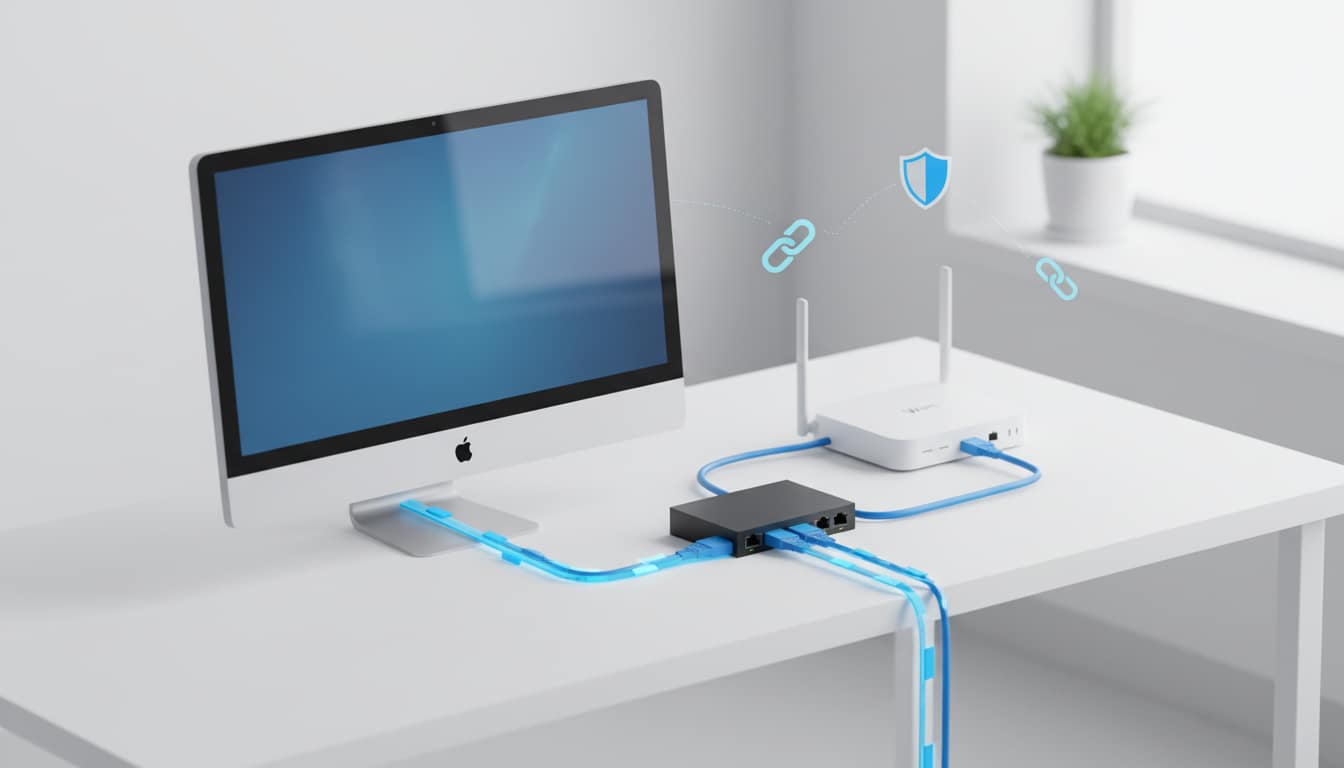
Ethernet delivers stable, speedy, secure wired connections to the internet and between devices.Before the widespread use of Wi-Fi, Ethernet was the go-to method for connecting devices to the internet. Ethernet cables were used in local area networks (LAN) or wide area networks (WAN) to transmit data. Despite the popularity of Wi-Fi, Ethernet remains a popular choice due to its speed, reliability, and security. For those seeking to maximize their internet connection, Ethernet is an excellent option, particularly for organizations that prioritize speed, security, and dependability. This article will provide a comprehensive overview of Ethernet. Additional resources include our guides on How to Buy a Router, Best Wi-Fi Routers, and Best Mesh Systems.
Updated in April 2026, this article now includes more detailed information about Ethernet, advice on cables, and a new section on Power-over-Ethernet (PoE) with recommended products.
The history of Ethernet dates back to 1973 when it was developed by a team of engineers at Xerox Palo Alto Research Center (PARC), including Robert Metcalfe and David Boggs. Ethernet facilitated the connection of multiple computers in a LAN, providing a protocol for rapid data transmission. The term Ethernet was inspired by the concept of luminiferous ether.
In a simplified version of Ethernet’s early history, Xerox gave up its trademark on the Ethernet name, leading to the Institute of Electrical and Electronics Engineers (IEEE) formalizing the 802.3 standard, also known as Ethernet, in 1983. Despite the existence of other technologies, Ethernet quickly became the dominant standard due to its open nature, allowing for networking equipment from various manufacturers. Ethernet was also easily upgradeable, with each version offering backward compatibility.
The first official Ethernet release supported speeds of up to 10 Mbps. This was followed by 100 Mbps Fast Ethernet in 1995, Gigabit Ethernet in 1999, and 10-Gigabit Ethernet in 2002. Power over Ethernet (PoE), which allows devices to use a single cable for power and networking, was introduced in 2003. Ethernet capabilities have continued to expand, reaching 40 Gbps in 2010, and 100 Gbps later the same year. Although research is ongoing, the highest speed available for home use today is 40 Gbps, which is more than sufficient for most users.
Even if you’ve only ever used Wi-Fi, you’re likely familiar with Ethernet plugs and cables. The cable that connects your modem to your Wi-Fi router or main mesh unit is probably an Ethernet cable with an RJ45 connector. Ethernet has three main advantages over Wi-Fi: it’s typically faster, more stable, and more secure. However, it requires running cables between devices, and the devices must have Ethernet ports. Setting up a network can also be a complex task.